The first artificial life constructs designed on the cell_a_v platform were simple self-replicating 'cells'.
Their basic building block is a 'DNA loop': a framed loop moving around a core. The loop contains 'DNA code' states mixed with 'space' states. The loop 'moves' by the code-states swapping places with the space-states - always in one direction.
The ratio of the code-states to the space-states is usually 3 to 1, resulting in
each code-state staying in the same spot for three time-ticks.
This allows building a frame larger than the code used to build it - in other words,
the replicate DNA-frame can be built with code that is only a fraction of the full code size
(so there is room to code other things).
The frame contains a 'starter state', which - when it comes in contact with the 'trigger state'
in the DNA-code - starts a 'builder' or a branching out of the DNA-frame. This creates a new DNA-frame
(after disconnecting from the original) and then the DNA-code is copied from the original cell.
And the whole cycle repeats...
You can see this in action in the Gallery.
There are also some old videos like this one on YouTube that we uploaded to our old channel way back in 2011. More of them are listed on the Videos page.
For explanation of the cell_a_v platform features, how the links between the states work, etc. see the Introduction .
As the cell_a_v platform development advanced, it added support for features like
These functions are performed by collections of related (and linked) squares - corresponding to organelles in cell biology.
To allow recreating theses structures during the reproduction, a technique had to be developed to record them in the DNA-code
in multiple 'genes' and then reading these genes and recreating the organelles in the new cell.
This process is again inspired by biology:
Each gene is identified by a unique key, which allows them to be read in correct order (irrespective of where they are located in the DNA) as well as using a specific gene to create a specific organelle based on a detected state of the environment (switchable genes).
The figure below shows an example of an advanced artificial world-cell.
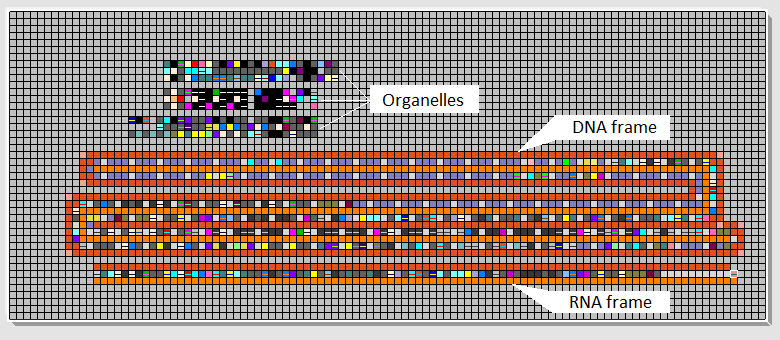
The s-shaped part in the middle is the DNA-frame containing the DNA code.
The part below that is the RNA frame, containing code of the last transcribed gene. The RNA frame is reused - the code of the next gene being transcribed overrides the previous gene's code.
The three parts above the DNA frame are the cell's organelles.
The bottom organelle is the 'gene loader'. It contains a glider gun and a detector for the next gene key, pointing to the DNA loop.
Because there is no gene-loader yet when the gene-loader organelle needs to be created, the ribosome to do that job is constructed by a 'bootstrap loader' created as a branch-off from the DNA loop.
The middle organelle is responsible for the cell's movement in the base world.
It detects the state of a number of squares around the cell's 'assemblage point'
(the other end of the wormhole connecting the cell to the base world) and based on that directs the cell's movement
to avoid obstacles.
For the details of this process see moving wormhole and
an animated illustration in the Gallery.
The top organelle is responsible for the cell's reproduction. When a trigger state is detected ahead of the cell in its path, the movement is stopped and the reproduction cycle is started:
You can watch the whole process in detail in the Featured Video on the Videos page,
or - if you prefer - directly on YouTube here.
We would love to hear from you!
If you find the cell_a_v platform interesting and/or if you are intrigued by the complexity of the artificial life it enabled to be created, or if you have questions or comments - please let us know.
We plan to set up a cell_a_v Forum soon, until then you can send us your feedback via the Contact page.
If you really like this work, have the means :-) and want to support further research and platform development, you can become our sponsor on Patreon or make a PayPal donation. Please see the Sponsors page. Thank you.
Although we use the terms like DNA, RNA, Ribosome, transcription and translation,
we do NOT claim that the artificial life constructs developed on the cell_a_v platform
accurately model or describe the real DNA, RNA, etc. (nor was that ever the intent).
However, the artificial constructs were certainly inspired by these concepts from Cell Biology and the parallels of their basic functionality should hopefully be quite clear - and in our view justify the use of these terms.
