The Gallery showcases animations illustrating the most interesting features of the platform and some of the artificial life forms and constructs.
Where applicable, links to YouTube videos are also included.
Entries are organized/grouped by themes, which are listed on the left. There is also a list of the latest additions.
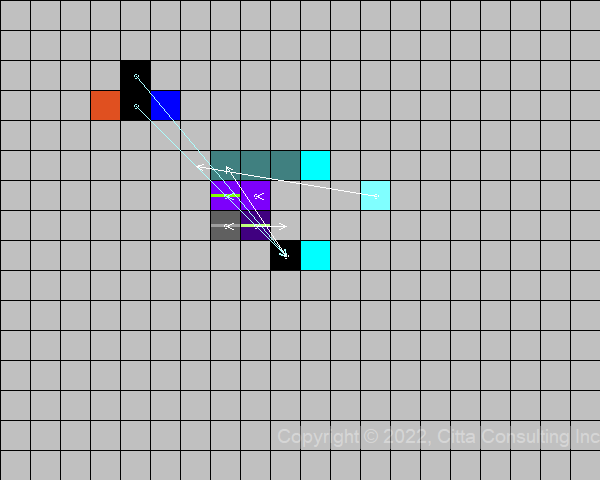
The glider in this example points to a mirror that follows a sequence of four squares and then jumps back to the beginning. Using a simple timer, the mirror target stays on each square three times. The states of these squares 'control' the glider to go forward (three times three) and then turn left.
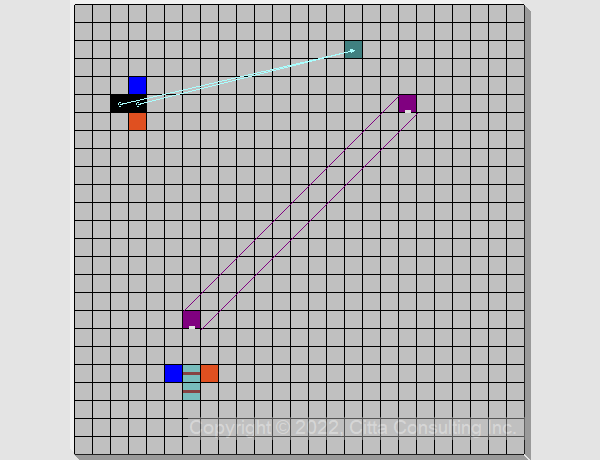
Two gliders go through a wormhole that connects two points in the same world.
The glider that moves vertically in this example is the 'basic' kind, not dependent on any other square.
Notice that the horizontal glider keeps going in the same direction after it emerges from the wormhole,
while the vertical glider goes up in one world and down in the other world (see explanation here).
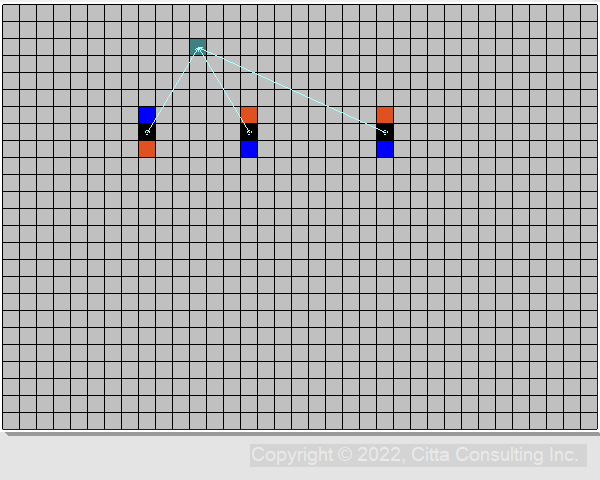
A head-on collision of two gliders creates a new 'popup' world connected via a wormhole, expanding to its pre-defined size limit
(defined in the project file metadata).
The third glider goes from one world into the other through the wormhole and back (and again...).
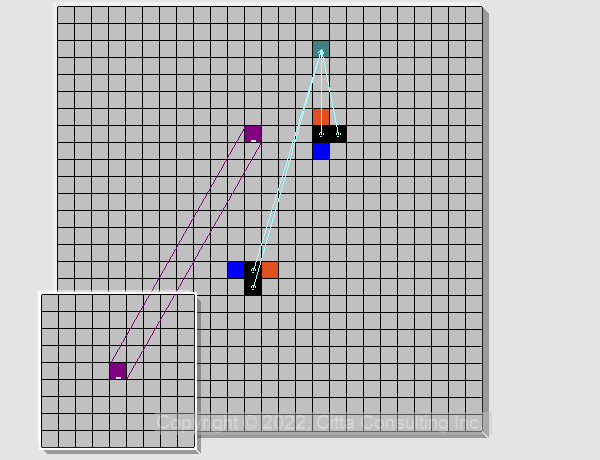
Two gliders go through a wormhole into another world and come back.
As in one of the previous examples, notice that the horizontal glider keeps going in the same direction after the wormhole,
while the vertical glider goes up in one and down in the other world (see explanation here).
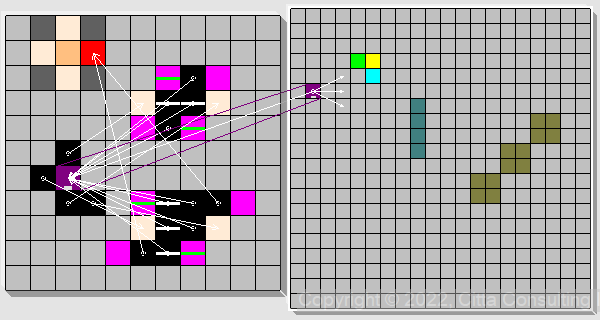
The mirror states surrounding the left end of the wormhole point at states that are the result of simple logic operation on the states that point through the wormhole into the other world and act like sensors or 'feelers'. Depending on the states of the cells/squares ahead of the right end of the wormhole a transient closed wormhole state is created either in front of or to the side, in effect 'moving' the wormhole end in that direction (see here for more details).
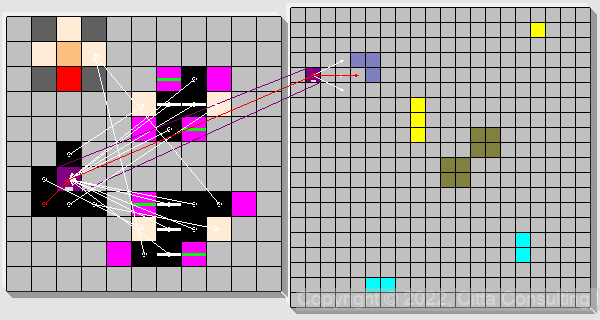
Similar to the previous example, with an addition of one more 'sensor' pointing straight 3 squares ahead. When it 'finds' (the link points to) the state l (aqua/blue) or r (yellow), the wormhole is rotated left or right, respectively.
Following are a few examples of simple self-replicating constructs.
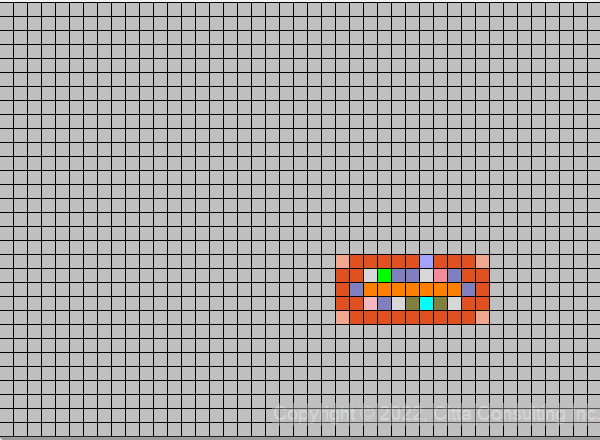
This is one of the simplest self-replicating 'cells'. All it does is to start a 'builder' to create another small 'DNA frame', disconnects it and changes it to a 'DNA tape'. The states around the tape move in a 1/3 tempo by swapping places with an empty 'space' (the ratio in most examples is 1 space to 3 'DNA code states'). The DNA code is then copied to the new tape... and the whole process repeats.
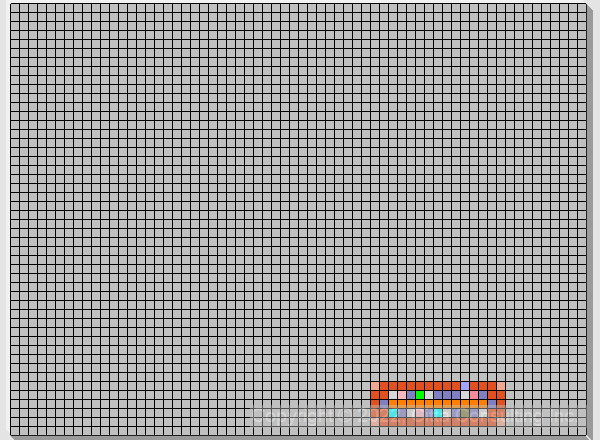
A slightly more complex sample with a 'cell' that has two 'offspring'. As you can see it gets quite crowded very soon, resulting in collisions and annihilation.
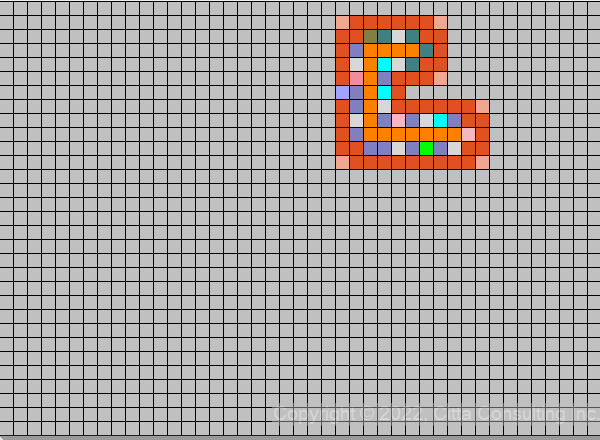
A variation of the above, but here one of the offspring immediately collides with the previous generation, making room for endless cycle of replication.
The more advanced artificial life forms are too large and complex to show effectively here.
To see those, go to the Videos page.
However, the following animations illustrate details of some of the components and processes involved.
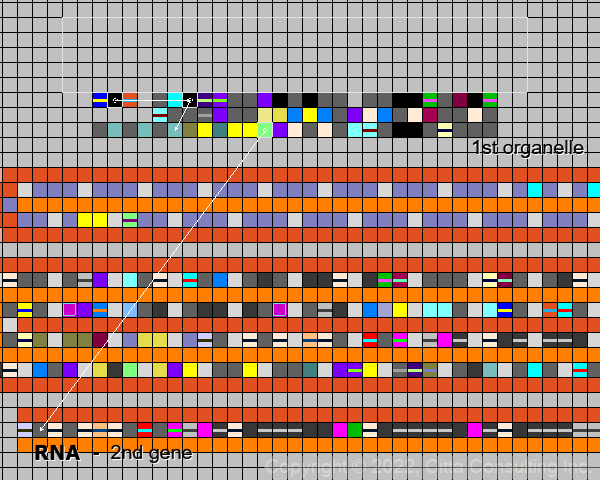
This animation shows the translation of the second gene - already transcribed in the RNA frame - into the second organelle. For detailed description of this process see Cell Description.
